
Laser hair removal on dark skin: is it safe? The complete guide
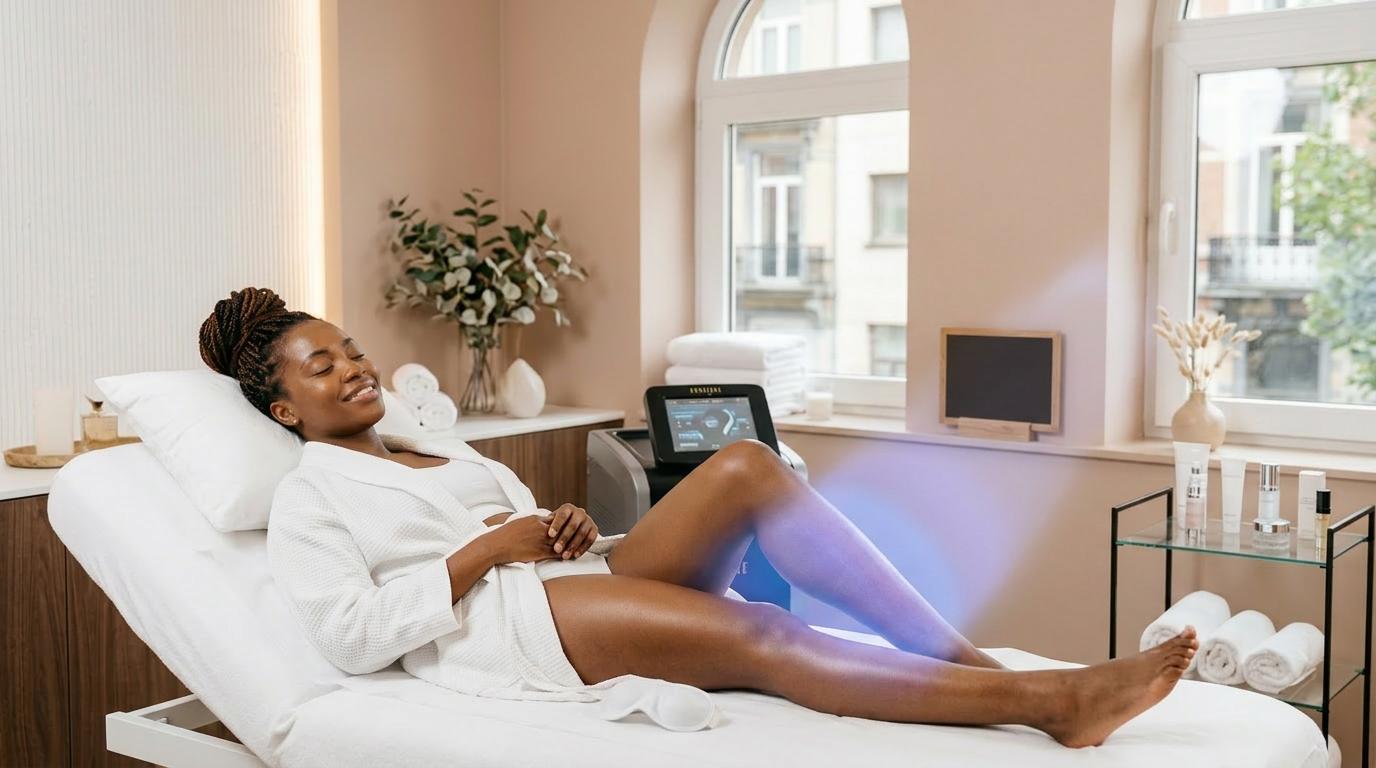
Ingrown hairs, razor bumps, dark marks after waxing: if you have tan, brown or black skin, you have probably considered laser hair removal on dark skin, only to give up for fear of burns. That fear has a real origin, but it largely belongs to the past. Here is how the technology has evolved, what to check before you start and how a course of treatment works on dark skin in a serious salon.
Laser hair removal on dark skin: why darker skin has long been a concern
The principle of laser hair removal is simple: a beam of light targets the melanin in the hair, and the heat travels down to the root and destroys it. The catch is that dark skin also contains a lot of melanin. With the first, poorly suited lasers, the energy was absorbed by the epidermis as much as by the hair, which could cause burns, scabs or lasting light or dark marks.
That is why so many people have heard that laser hair removal on dark skin was not recommended. Today, recent devices offer deeper wavelengths and longer pulses that can be adjusted to the skin type. If you would like to understand the general technique first, our page on laser hair removal in Brussels explains how the diode laser works.
Laser hair removal on dark skin: how the laser works without damaging the epidermis
On dark skin, safety rests on three levers found in any serious protocol. They explain why results can be effective without the skin surface overheating:
- A deep wavelength that passes through the surface layer to reach the root of the hair in the dermis.
- Long, gradual pulses that heat the follicle without overloading the epidermis.
- Constant cooling of the area, here with a sapphire tip, which protects the surface and improves comfort.
Every setting is adjusted to the hair, the area and the shade of dark skin. It is this case-by-case adjustment, not raw power, that makes the difference between a safe session and a risky one. A salon that uses the same settings for every client is not the right choice for laser hair removal on dark skin.
Dark skin and skin types IV to VI: what really changes
Professionals classify skin into six skin types, from lightest to darkest. Types IV, V and VI correspond to tan, brown and black skin. The more melanin the skin contains, the lower the contrast with the hair and the more caution is needed: energy is increased gradually and sessions begin with a test on a small area.
Another particularity: on dark skin, hair is often curly or curved, which encourages ingrown hairs, folliculitis and post-inflammatory marks. That is precisely one of the best reasons to choose laser over razor or wax, which keep the problem going. Waxing in Brussels remains an option for areas where laser is not suitable, for example on very light hair.
Preparing for laser hair removal on dark skin: the right habits
A successful session is prepared several weeks in advance. The guidelines below limit the risk of a reaction and let the laser work in the best conditions:
- Shave the area 24 hours beforehand with a new razor, with no wax or epilator: the hair must stay in place under the skin.
- Avoid sun and self-tanners for the 3 to 4 weeks beforehand, as tanned skin is more sensitive.
- Stop depigmenting products or harsh exfoliants on the area, as advised at the assessment.
- Tell us about any treatment or photosensitising medication on the day of your appointment.
Also remember to moisturise your dark skin throughout the course. Supple, comfortable skin tolerates heat better, and laser hair removal on dark skin becomes all the more pleasant.
How many sessions of laser hair removal on dark skin should you plan for?
Hair grows in cycles, and the laser only works on hairs in their growth phase. That is why a course needs several visits: you should generally plan 8 to 10 sessions for a lasting result, spaced a few weeks apart depending on the area. The face often needs a closer rhythm than the legs.
A session lasts from 15 minutes for small areas to an hour and a half for an extended package. On dark skin, hair becomes finer and sparser as the course goes on, then disappears on most areas. As with any permanent hair reduction, the result depends on each person's hormones and body: maintenance sessions may be useful afterwards.
After the laser: looking after dark skin properly
The days after the session matter as much as the session itself. Dark skin tends to mark more easily when irritated, so it is best to spare it any aggression for about a week. Here are the habits to adopt so the course goes smoothly:
- Moisturise morning and evening with a soothing, fragrance-free and alcohol-free product to support regrowth gently.
- Protect the area from the sun with a high-factor sunscreen, even in winter on the face and hands.
- Postpone sauna, steam room, very hot baths and scrubs for a few days after each session.
- Do not pluck hairs between sessions: shaving is allowed, waxing and tweezers are not.
Hairs may seem to regrow or fall out in small clumps in the two weeks that follow: this is normal, it is the destroyed hairs being shed. For successful laser hair removal on dark skin, regular appointments matter most, and our team adapts the schedule to each area.
Laser hair removal on dark skin in Saint-Gilles: how it works at Ô Zen
At Ô Zen, nothing is left to chance. Every course starts with an individual skin assessment and a tolerance test so the beam can be adapted to your skin. The session then proceeds area by area, with sapphire cooling, in a calm treatment room on Avenue Jean Volders in Saint-Gilles, close to Porte de Hal.
After the session, the skin may be slightly pink for a few hours. We apply a soothing treatment, and you avoid sun, hot baths and scrubs for a few days and protect the area with sunscreen. All the practical information is on our dedicated page on laser hair removal on dark skin in Brussels, where you can also book online 24/7. For men, the page on laser hair removal for men in Brussels presents the most requested areas.
Ready to try laser hair removal on dark skin ?
Book your appointment online in real-time at Ô Zen Esthétique in Saint-Gilles.
Frequently asked questions about this article
It is when performed with a device suited to darker skin types, personalised settings and continuous cooling. The risk does not come from skin colour but from unsuitable equipment or protocol.
That is why a skin assessment and a prior test are essential before any course.
The main risks are temporary redness, superficial burns and pigment changes if the setting is too high or the skin is tanned. They are limited by preparation (no sun, shaving the day before) and by a test on a small area.
Yes. Avoid sun exposure and self-tanners for the 3 to 4 weeks before the session, then protect the area with high-factor sunscreen afterwards. Tanned skin absorbs more energy and reacts more easily.
The sensation is described as small bursts of heat or tingling, varying by area. Sapphire cooling makes the session more comfortable. Sensitive areas such as the bikini line or face are felt the most.
Yes, in most cases. By gradually removing the hair, laser reduces ingrown hairs, folliculitis and the dark marks that follow. The improvement is usually visible over the first few sessions.
Generally 8 to 10 sessions, spaced a few weeks apart. The exact number depends on the area, hair density and hormonal factors. An assessment lets us give you a personalised estimate.